
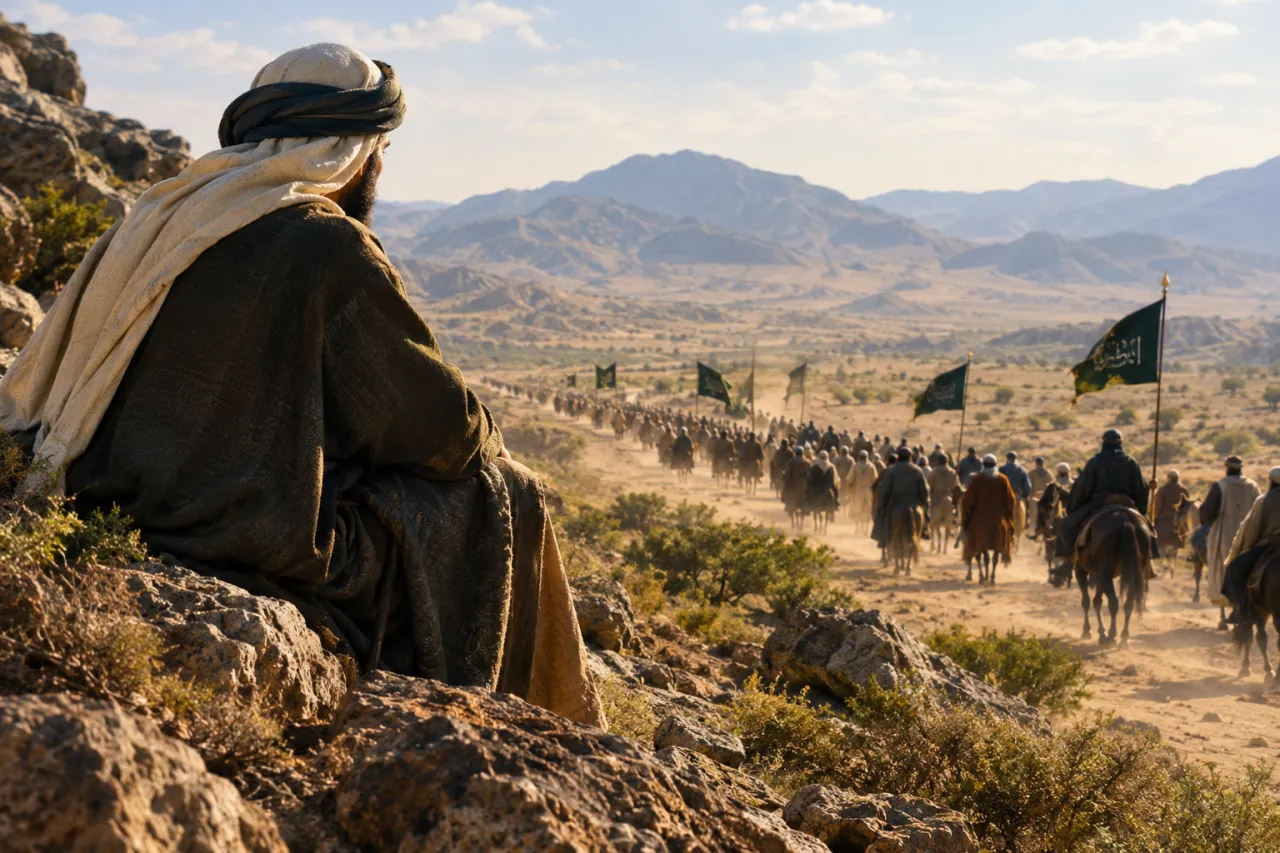
Ka'b ibn Malik and the Expedition of Tabuk: Why He Stayed Behind
Ka'b ibn Malik (may Allah be pleased with him) missed the Expedition of Tabuk because he kept putting off his preparations until the army had left. When the Prophet Muhammad (peace be upon him) returned to Medina, Ka'b told him the truth and made no excuses. After a 50-day boycott and a severe trial, his repentance was accepted. Narrated in Sahih al-Bukhari and Sahih Muslim, this story is one of the most instructive episodes in the Seerah.
The Return from Tabuk
On the way back from Tabuk, a group of hypocrites tried to assassinate the Prophet (peace be upon him). They planned to frighten his camel so that it would throw him off a cliff. Hudhayfah (may Allah be pleased with him), who was riding beside him, noticed the plot in time and scared the hypocrites' camels with his stick, and the plan failed. When the Prophet returned safely to Medina, the people welcomed him with the same great joy they had shown on the day of the Hijrah. Then began the matter of those who had stayed behind.
Those Who Stayed Behind Present Their Excuses
The Prophet (peace be upon him) went to the mosque, prayed two rak'ahs, and sat down to listen to the people. More than eighty men came forward and offered their excuses. He accepted what they showed outwardly, asked Allah's forgiveness for them, and left what was in their hearts to Allah. Ka'b ibn Malik, Murarah ibn al-Rabi', and Hilal ibn Umayyah, however, made no excuses. They said, "We were overcome by our own selves." The Prophet told them to wait until Allah decided their case.
When Does Jihad Become an Individual Obligation?
Ka'b had also missed the Battle of Badr, yet nobody blamed him then, because no general mobilization had been called there. At Tabuk, however, a general mobilization had been announced. According to scholars, jihad is normally a communal obligation (fard kifayah), but it becomes an individual obligation (fard 'ayn) in three situations:
- When the leader announces a general mobilization
- When an enemy invades Muslim lands
- When two armies face each other on the battlefield
At Tabuk, staying behind from an individual obligation was considered a major sin, so a penalty was imposed.
Lessons from the Story
The Disease of Procrastination
Ka'b had no desire to disobey, and he had none of the objections the hypocrites raised. He simply kept saying, "I can catch up in a day or two," and kept delaying until the opportunity slipped away. The principle is to hasten toward good deeds. Every delay gives Satan's influence a little more strength. The cure for procrastination is to stop delaying and act.
Past Achievements Do Not Guarantee the Future
Ka'b had pledged allegiance at al-'Aqabah and had passed many trials. Still, he stumbled at Tabuk. Devotion to Allah is a living process, and a person must keep examining his heart and his faith.
What the Heart Clings To
Ka'b mentions the harvest, the shade, and the fruit. When the heart attaches itself to worldly things, a person either fails to start the deed or fails to do it properly. The warning at Uhud, "Some of you desired this world," shows the same thing.
Innocence Is the Default
When the Prophet (peace be upon him) asked about Ka'b, one man accused him of arrogance. Mu'adh ibn Jabal replied, "We know nothing but good about him." A Muslim should first be thought well of. Once a ruling is made, one should abide by it, as Mu'adh did.
Honesty Means Owning Your Mistake
Ka'b thought about lying, but he decided that honesty would save him. People can be persuaded, but Allah, who turns hearts, cannot be deceived. The mark of a hypocrite is to blame others for his faults, while the mark of a believer is to own his mistake.
The Higher the Rank, the Greater the Responsibility
Those who told the truth endured fifty days of hardship, while those who lied were let go. There are two reasons for this. First, the higher a person's rank, the more is expected of him and the greater his responsibility. Second, when Allah wants good for a servant, He punishes him in this world. The three Companions were purified in this world so that they would not be ashamed on the Day of Judgment.
Trials Come One After Another
During his ordeal, Ka'b received a letter from the ruler of Ghassan inviting him to join them. He saw it as "another kind of affliction," threw the letter into a clay oven, and burned it. Anything that carries evil should be removed at once.
The Boycott Is for Reform, Not Punishment
The purpose of the boycott is reform. Once reform is achieved, the boycott (hajr) comes to an end. The community stood like a mountain behind the decision and did not react emotionally.
How the People in the Story Responded
| Topic | Those Who Made Excuses (80+ men) | The Three Who Told the Truth |
|---|---|---|
| Attitude | Swore oaths and offered excuses | Admitted their mistake |
| Result in this world | Their excuses were accepted | Fifty-day boycott; the earth felt narrow to them |
| Final outcome | Their affairs were left to Allah | Their repentance was accepted |
| Lesson | Lies bring only temporary relief | Honesty brings lasting salvation |
Repentance Accepted and the Good News
On the morning of the fiftieth day, Ka'b heard a voice from the mountain of Sal' calling, "Good news, O Ka'b!" and he fell into prostration. Medina was filled with a festive joy. Ka'b gave the messenger the two garments he was wearing. The Prophet (peace be upon him) told him, "Rejoice in the best day you have had since your mother bore you." For a believer, the best day is the day his repentance is accepted.
In the mosque, only Talhah ibn 'Ubaydillah stood up to congratulate him, and Ka'b never forgot it. People do not forget those who stood by them in hard times and shared their joy. Ka'b wanted to give away all his wealth, but the Prophet told him to keep part of it. Ka'b then vowed never to depart from honesty for the rest of his life.
Misusing This Story
This story cannot be used to label those who do not join one's own cause as "those who stayed behind." No one who raises a banner today is the Prophet (peace be upon him). Using the story as a weapon against opponents puts a religious text in the wrong place.
Frequently Asked Questions
Why was Ka'b ibn Malik punished?
He stayed behind from an individual obligation, because a general mobilization had been announced.
How long did the boycott of the three Companions last?
Fifty days. Allah accepted their repentance in Surah At-Tawbah (9:118–119).
What is the main lesson of the story?
Do not procrastinate, own your mistakes, and never abandon honesty.