The Birth of Prophet Muhammad and What Happened Around It
If you have ever wondered when and how the Prophet Muhammad (peace be upon him) was born, you are not alone. It is one of the most asked questions in Islamic history, and the answer comes to us through the classical biographies of the Prophet, the sīra literature. According to the most common accounts, he was born in Mecca in the Year of the Elephant, on a Monday morning in the month of Rabi al-Awwal. In the Gregorian calendar, that places his birth around the spring of 571 CE.
To understand why the birth mattered so much to early Muslims, it helps to picture the world he was born into. Mecca was a busy trading city, but belief had drifted far from the monotheism of Abraham. Idols filled the Kaaba, tribal violence was common, and many people lived in ignorance and injustice. It was into this setting that a child was born in an ordinary house, and the stories that followed would shape how generations of Muslims understood his arrival.
Amina’s dream and the night of the birth
His mother, Amina, later described a series of strange experiences during her pregnancy. In one account, during the sixth month, she dreamed that someone came to her and said that she was carrying the best of creation. When the child was born, she was told, he should be named Muhammad. She was also instructed not to speak about it to anyone
The traditional narrations describe the night of the birth in vivid terms. Amina’s father-in-law, Abdul Muttalib, had gone to perform circumambulation around the Kaaba. Alone in the house, Amina heard a frightening sound and felt overwhelmed. She then saw a white bird near her, and a cup of drink was offered to her. After she drank, she said she felt surrounded by a sea of light. The child was born shortly after, and the accounts describe him in prostration, his finger raised toward the sky.
Scholars treat these details with care. They come from later narrators, so historians debate their exact wording. For Muslims, however, they are a way of expressing how important the child was from the very beginning.
Signs in the sky and beyond
The sīra books also record reports of signs that were said to appear across the world on the night of his birth. According to these accounts, Jewish scholars who studied their scriptures had long expected a final prophet, and some of them noticed a bright star that night. One report describes a Jewish man in Mecca who told the Quraysh that a boy had been born whose sign was on his back, and that the age of prophecy had passed to the Arabs.
Other traditions speak of a royal palace in Persia. In these reports, the palace of the Sasanian king Khosrow trembled, fourteen of its towers collapsed, and the sacred fire the Persians had kept burning for centuries went out. When the king asked his advisers for an explanation, a soothsayer named Satih in Syria was said to have confirmed that a new prophet had come and that the Persian rule would fall.
Historians are cautious about these narrations, and it is important to say so. Still, they show how deeply the birth was remembered and how early believers saw it as a turning point.
Halima and life in the desert
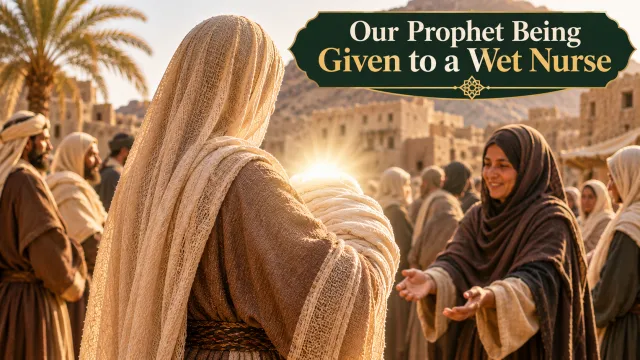
In that period, it was common for wealthy Meccan families to send their infants to live with Bedouin women in the desert for the first years of life. The desert air was considered healthier, and the children learned clear speech from tribes known for their eloquence. This is how the baby Muhammad came to be placed with Halima bint Abi Dhuayb of the Banu Sa’d tribe.
Many of the women who arrived in Mecca that year turned down the orphan, because a child without a father meant a smaller reward. Halima accepted him anyway. When she brought him back to her household, her husband Harith noticed something unusual. Their camels, which had been weak, now gave milk, and the household seemed to flourish.
The stories from the desert keep going. Her neighbors noticed that her flock grazed on the same land as everyone else’s, yet hers gave plenty of milk while others did not. When a drought struck the region, Halima’s family found that their household remained blessed. The accounts describe a small cloud that shaded the child as they traveled home, even though the sun was harsh.
The rain that came through a child
Perhaps the most memorable story is the one about rain. After a long drought, the people of the tribe went out to a hilltop to pray for rain, but nothing came. A monk or elder reminded them that the blessed child living with Halima might be the reason their prayers could be answered. Halima brought him to the gathering, and while the people prayed, a small cloud appeared. It grew until it covered the sky, and rain began to fall.
The narrators note that the people did not fully understand what they had witnessed. For Muslims, though, this is one of the early signs that Allah had set him apart from the beginning, long before he received revelation at the age of forty.
What these stories teach us
Stories about the Prophet’s birth are not only a source of historical curiosity. They carry a lesson about how a person’s character and mission can shape the world around them. Mecca was dark and divided when he was born, and the message he later brought would light up hearts and communities across the centuries.
It is also worth remembering the hardship of his early life. His father died before he was born, and his mother died when he was still a young child. He grew up as an orphan, which taught him patience, humility, and reliance on Allah. The birth stories point to a child who, from the first moments, was destined to become a mercy to all the worlds.
This article summarizes narrations found in classical Islamic biographies. For a deeper reading, see Ibn Sa’d’s Tabaqat and Ibn Hisham’s Sirat Rasul Allah.
Frequently asked questions
When was Prophet Muhammad born?
Classical sources place his birth in Mecca in the Year of the Elephant, around 571 CE, on a Monday in Rabi al-Awwal.
Were there miracles at the Prophet’s birth?
The sīra literature, including works by Ibn Sa’d and Ibn Ishaq, records a number of extraordinary reports. Muslims regard these as expressions of faith. Historians note that the reports come from later narrators and should be read with that in mind.
Why did Halima nurse the Prophet?
Wealthy Meccan families commonly sent infants to Bedouin women in the desert for their early years. Halima was one of the women who took him in under this custom.